When you hire someone to help with your marketing, it’s natural to assume they’re measuring what matters most to you: new customers and revenue. But most marketing reports stop at the moment someone calls or fills out a form. What happens after that, whether the lead became a paying job, usually isn’t in the report at all.
That gap isn’t anyone’s fault. It’s simply where the marketing tools end and your business begins. But closing it is one of the most valuable things you can do for your marketing.
Why does it matter which leads became paying jobs?
Because it tells you which marketing is actually working. Clicks, calls, and form submissions show that people are interested. Knowing which of those people became customers shows what’s bringing in revenue, so you can put more behind what works and less behind what doesn’t. The more you know about your sales, the better your marketing can get.
Once you can connect leads to paying jobs, a whole set of useful questions start to have answers:
- Which campaigns brought in customers, not just enquiries?
- Which searches did those customers use to find you?
- Which pages on your website lead to the most enquiries, and the best ones?
- Which services or products did those customers end up buying?
Every one of those answers depends on knowing which leads turned into actual sales. Without that piece, even good marketing is making educated guesses.
What is closed-loop tracking?
Closed-loop tracking, sometimes called closed-loop attribution, simply means following a lead all the way from where it came from to whether it became a sale. The “loop” is closed when the outcome of each lead, won or lost, is connected back to the marketing that brought it in.
In practice, that usually involves two parts:
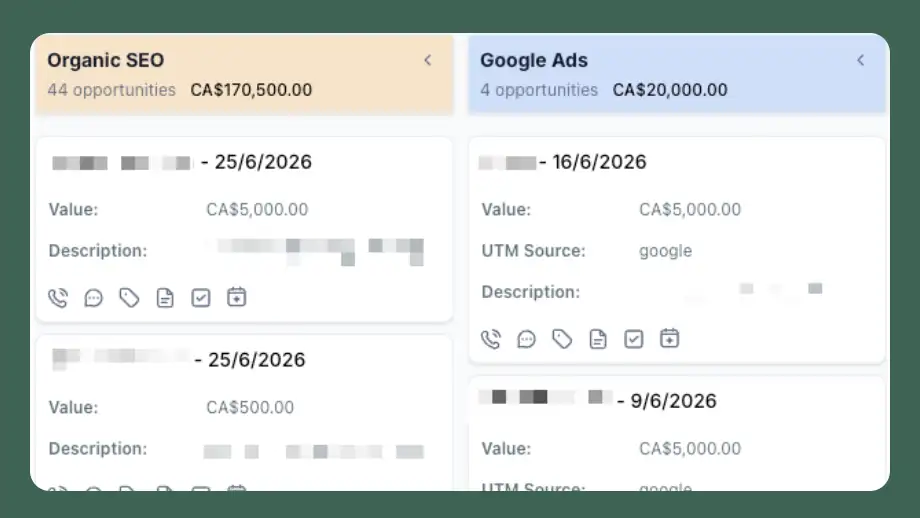
- Capturing where each lead came from. Small tags added to ad and website links can record the source of each form submission, such as a specific Google Ads campaign. Phone calls are harder to trace, and call tracking numbers are one common way to connect a call to the ad or listing that prompted it.
- Recording what happened next. Each lead goes into a list or a CRM (customer relationship management software), where it’s marked as won or lost, ideally with the job value.
It won’t be perfect. Word of mouth, repeat customers, and people who find you several different ways will always blur the picture a little. But even a mostly complete picture is far more useful than none.
Where do leads usually get lost?
Most of the time, it’s in the handoff. A lead comes in from the website and someone starts a conversation with them. A week later, that same customer calls back and speaks to a different person, who books the job. The second person may not know where the customer first came from, and the first person may never find out the lead turned into a sale.
Once a lead is inside the business, it tends to live in whatever system the business already uses: an inbox, a job management tool, a notebook, or someone’s memory. None of that is wrong. It just means the connection between the marketing and the sale is easy to lose, especially when things are busy.
How can you start tracking leads to sales?
You don’t need a complex system to begin. One simple approach works with the tools most businesses already have:
- Export the enquiries from your website’s contact forms for the last 30 to 60 days into a spreadsheet.
- Remove the spam and anything that isn’t a real enquiry.
- Go through the list and note which of those people became paying customers, and roughly what the job was worth.
Even that one exercise can be eye-opening. From there, the next step is making it routine: capturing where every lead came from as it arrives, and recording the outcome as part of your normal process, so you’re not piecing it together months later.
Do you have to share your revenue?
No. Some owners are happy with the leads they’re getting and would rather keep their sales figures private, and that’s entirely their call. Marketing can still be measured on the quality and number of enquiries.
But for owners who want their marketing to keep getting smarter, knowing which leads became paying jobs is what makes that possible. It turns marketing decisions from guesses into choices based on what’s actually bringing in business. If you’d like to see how the numbers add up once you know your results, the True ROI Calculator can help.
Setting this up takes some care: tagging your ads and forms correctly, connecting them to a place where leads are recorded, and making sure outcomes actually get logged. I build that into how I work with clients, capturing where each lead comes from and then going through the leads together regularly to see which became paying jobs. If you’d like to talk about getting that kind of clarity for your business, let’s schedule a call.