How much should you spend on marketing? It’s one of the most common questions business owners ask, and there’s no single right answer. The right number depends on your business: what a customer is worth to you, how much you want to grow, and what you can comfortably invest.
What does exist is a handful of well-established ways to work it out. This article walks through the three most practical ones for a small business, what each is good for, and where each falls short.
What are the common ways to set a marketing budget?
Marketing textbooks describe four standard methods: a percentage of sales, what you can afford, matching your competitors, and working backward from your goals (known as the objective-and-task method). Matching competitors is hard for a small business, since you rarely know what they spend, so this article focuses on the other three.
You’ll also see averages quoted online, like the 8 to 9 percent of revenue often mentioned. Most of those figures come from surveys of large companies, many with revenue in the billions, so treat them as background rather than a target.
Approach 1: Use a percentage of revenue.
The simplest method is to set aside a fixed share of your revenue. A senior advisor at the Business Development Bank of Canada (BDC) suggests 5 to 10 percent for businesses that sell to consumers, and 2 to 5 percent for businesses that sell to other businesses.
For a business with $800,000 in annual revenue, 5 to 10 percent works out to $40,000 to $80,000 a year, or roughly $3,300 to $6,700 a month.
It’s quick to calculate and keeps marketing in proportion to the size of your business. The trade-off is that it’s based on where you are, not where you want to go, and it doesn’t account for what a customer is worth to you. It’s also guidance from experienced advisors rather than a measurement of what similar businesses actually spend.
To try it with your own numbers, the calculator below gives a quick reference point.
What would a percentage-of-revenue budget look like?
Try different numbers to see what this common budgeting method suggests for a business like yours. It’s a starting point for thinking it through, not a recommendation.
Your total gross revenue over the last 12 months, or your target for this year.
Pick the closest match, or leave on General for a broad range.
Add this to see how it compares to the reference point.
Revenue-based reference point
—
—
Annual equivalent
—
Range used
—
Where do these numbers come from? ↓
- “B2B & Professional Services” (2–5% of gross revenue) and the broader 5–10% guideline for consumer-facing businesses both reflect the Business Development Bank of Canada’s (BDC) published small-business marketing guidance.
- The four consumer-facing categories (ranging 6–12%) are Chris Bryant’s own refinement of that broader BDC range, based on his judgment of these business types. They are not a separately published dataset.
- Want a second opinion for your own industry? Innovation, Science and Economic Development Canada’s Financial Performance Data tool lets you generate a real report of income and expense benchmarks by industry code and revenue size, using Statistics Canada data.
- “Maintain & Protect” applies the lower end of the range for your chosen category, while “Strategic Growth” uses the upper end.
- These are reference points, not a prescription. Your ideal operational budget should always be tailored to your specific profit margins, local competition, and capacity.
Approach 2: Work backward from the growth you want.
Working backward starts with a goal, such as a number of new jobs each month, and estimates what it would cost to win them. The textbook version of this method calls it “a more rational and ideal approach,” because it ties your budget to what you want to achieve.
Here’s a simple example. A renovation contractor specializes in bathrooms and wants two more jobs a month. In Vancouver, a mid-range full bathroom renovation typically runs $22,000 to $45,000, so we’ll use $30,000. Three numbers from their own business do most of the work:
- Average job value: $30,000.
- Gross margin: the share of each job left after materials and labour. US remodelers averaged about 30 percent in the National Association of Home Builders’ latest study, so each job leaves about $9,000.
- Close rate: how many enquiries become paying jobs. If it’s one in four, it takes four leads to win one job.
If four leads cost more than $9,000, the job loses money. So the break-even point is $2,250 per lead. You’ll want to spend comfortably below that, and how far below is your call.
| Step | Example |
|---|---|
| New jobs wanted each month | 2 |
| Leads needed at a 25% close rate | 8 |
| Break-even cost per lead | $2,250 |
| Most you could spend before losing money | $18,000 a month |
| Budget if leads cost about $250 each | About $2,000 a month |
The gap between those last two numbers is the point. When a single job is worth tens of thousands of dollars, you can afford to pay far more for a lead than most owners assume.
To see whether your goal is realistic, compare your numbers with what leads tend to cost. The most detailed published figures are American: WordStream and LocaliQ report average Google Ads costs from roughly US$73 per lead for dentists to US$228 for roofers.
Approach 3: Go with a budget you can comfortably afford.
The third method starts with cash flow: decide what you can set aside each month without putting pressure on payroll, suppliers, or your own peace of mind. It’s common among small businesses because it’s practical and keeps spending under control.
Its known weakness is that it doesn’t tell you whether the amount is enough to reach your goals, and it can lead to underspending. That’s why it works best alongside the other two. If what you can afford comes close to what they suggest, you’re likely in a good place. If it falls well short, you may want to adjust the goal or start with one channel and build from there.
Whatever number you choose, it helps to be able to stick with it long enough to see results. Some channels, like Google Ads, can bring in enquiries within weeks, while SEO usually takes several months.
What does a marketing budget actually pay for?
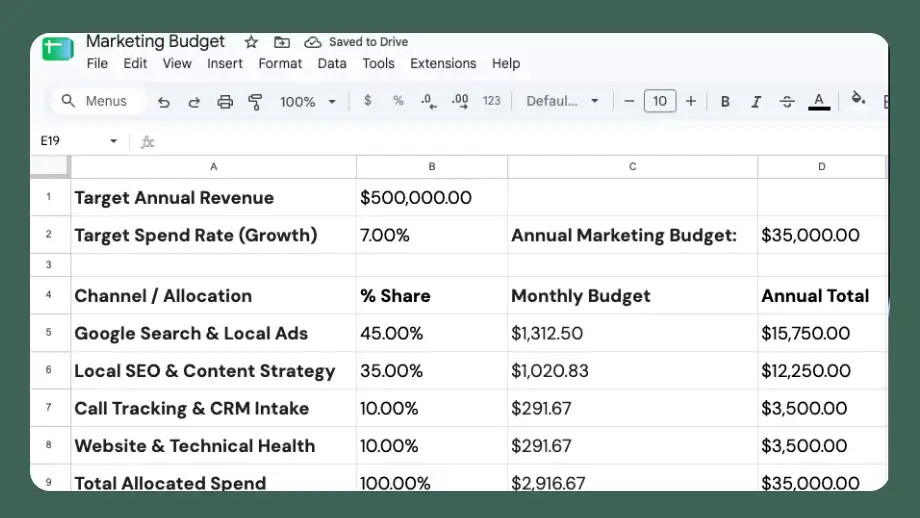
When planning your monthly numbers, it helps to understand that a digital marketing budget breaks down into two distinct buckets: platform ad spend and strategic management.
- Direct Ad Spend: This money goes directly to platforms like Google or Meta to display your ads. For local service businesses targeting a specific region, a reasonable starting point for Google Ads usually begins around $1,000 to $1,500 per month.
- Management & System Execution: This portion covers the actual expertise required to generate ROI: strategy, web design, landing page optimization, copywriting, SEO, campaign management, and tracking.
Understanding this split prevents a common budgeting mistake: setting aside $2,000 a month and assuming all $2,000 goes into buying ad clicks, leaving zero resource for the landing pages, strategy, and tracking required to actually convert those clicks into calls.
Putting your budget into practice
No formula can replace a realistic look at your specific margins, local competition, and capacity for growth. The goal of setting a budget isn’t to hit an arbitrary percentage, but to give your business a clear, sustainable baseline that supports real return on investment over time.
If you’d like to map out your numbers or run them through a customized calculator, try my free marketing budget calculators, or schedule a brief call to review what a realistic strategy looks like for your business goals.